
By Pam Wright
Local Journalism Initiative Reporter
The Rivard Pumping Works isn’t popular with tourists or the public, but its importance to Chatham-Kent can’t be understated.
Located in the former Dover Township close to Lake St. Clair, the Rivard system is said to be the largest pumping scheme by area in Canada. It drains 33,000 acres (13,335 hectares) of an area encompassing Chatham’s north side and critical farmland all the way east to Louisville.
As part of increasing awareness about the importance of the Rivard, and other municipal drainage infrastructure – the Kent Federation of Agriculture organized a recent tour of the station.
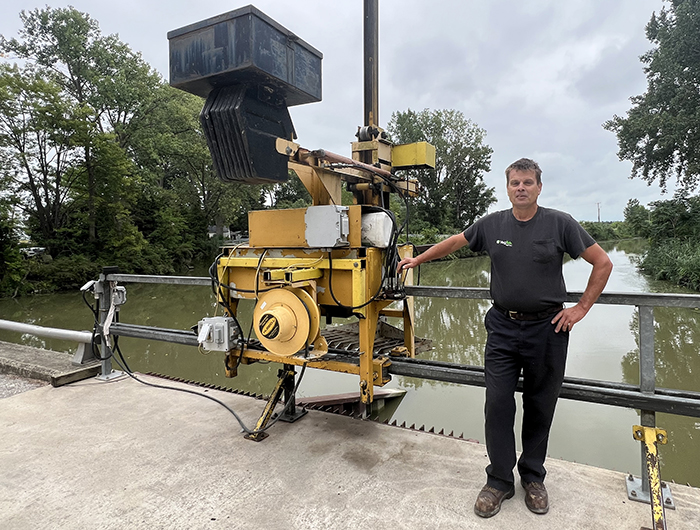
Hosted by Rivard Pumping Works commissioner Kevin Bagnell, participants got a close-up view of a system few people know about, but many rely on.
Bagnell, who has been looking after the Rivard works since 2015, said preventing flooding requires ongoing surveillance.
“It’s a constant monitoring of what’s needs to be done,” Bagnell said during the tour. “When it needs to be done, we get on it to get rid of the water that’s on the farms.”
Constructed in 1988 at a cost of around $900,000, the Rivard was built following a petition to the former Dover Township from farmers and residents worried about the effects of high water on the land. Flooding has long been a concern in the flat lands of the municipality.
A total of 59 pumps and 140 miles of drains feed into the Rivard site, as well as pumps on private property. It’s part of a complex system of 4,000 drains throughout Chatham-Kent which run on for 4,200 kilometres, compared to 3,400 kilometres of roads in the municipality.
Bagnell, a farmer and co-owner of an agricultural spraying company, was mentored by former commissioner Bob Goudreau who tended the Rivard pumps for more than 20 years.
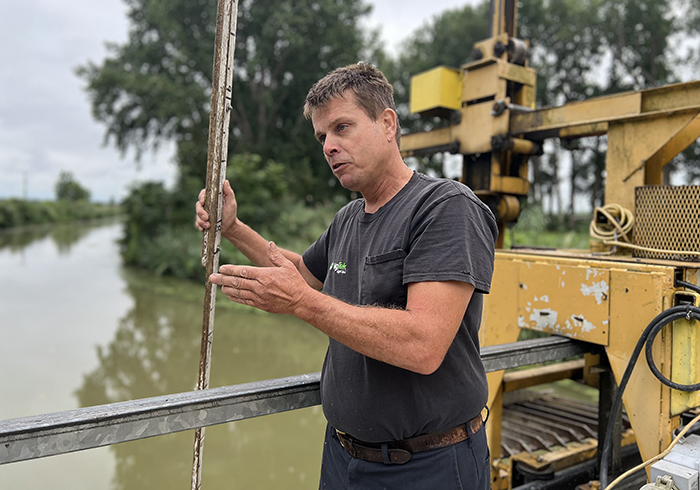
He still does things much the same way as his predecessor, looking after the two 400 HP Caterpillar engines. Bagnell still uses a measuring pole Goudreau devised and he keeps a close watch on the weather. If storms come, he’s on the scene.
Draining the land by pumping the water off is critical, Bagnell explained, noting timing is everything, particularly for sowing vegetable crops like peas and carrots.
“It’s an extremely vital part of agriculture,” Bagnell explained. “I think it’s more important than having the right equipment to put the crop in the ground, because if we don’t have the conditions to plant at favourable times, without the water being removed from the soil, we’re not going to get the crops in on time.”
To date, the Rivard pumping system has held up for decades and there’s never been a mechanical failure. Someone, including several staff members, is always at the ready to deal with rainfall events, which have become more extreme in recent years.
“My whole focus is to keep it running as it does,” Bagnell said.
That comes easier when Lake St. Clair water levels are low compared to the effort required when lake levels are high, he explained.
Investment by Chatham-Kent to enlarge and modernize the Rivard works is being considered, Bagnell told the gathering, which would double the capacity. It’s currently estimated the project would cost $6 million.
But it won’t materialize any time soon.
“If it happens, it’s going to be a very intense undertaking,” Bagnell stressed.
Pumps at the Rivard are currently powered by diesel fuel, however these would likely be changed to electric with a backup generator system.
According to C-K drainage superintendent Ellen Sinclair, there is an ongoing engineering report for the Rivard pump where doubling its capacity is being considered.
In an email message, Sinclair said there are many other factors being looked at as well, but a final design has not been determined at this point.