
Nearly one in four families in Chatham-Kent experiences food insecurity.
This from Dr. Shanker Nesathurai, medical officer of health.
In addressing the board of health March 23, Nesathurai said 23.4 per cent of C-K households suffer from food insecurity, which, simply put, is when a family does not have enough food or is not sure they can get food.
That’s up from 2024 where one in five local households suffered with food insecurity in Chatham-Kent.
The problem, health officials said, is lack of income.
“Food insecurity in Chatham-Kent is driven by inadequate and insecure income, not a lack of food,” Coun. Carmen McGregor, chair of the Chatham-Kent Food Policy Council, said in a media release. “When people do not earn enough to cover housing, transportation, and food, they’re forced into impossible choices.”
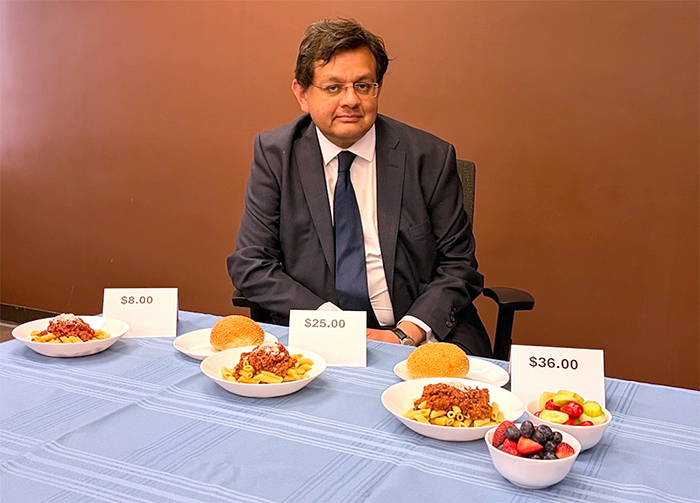
Nesathurai used a pasta dinner as an example of the differences in food affordability. He said for a family who only has $8 to spend on dinner, you could get pasta and canned tomato sauce.
“Not the most appealing meal,” he said. “If you had $25, you could add some meat, some parmesan cheese and you can buy rolls.”
For a few more dollars, a family could add salad and some fruit.
“I think that’s a wonderful meal, but not a luxurious meal,” Nesathurai said.
But that type of meal, he said, costs a family more than $1,000 a month. And that cost does not factor in the price for items for breakfast and lunch.
Nesathurai said the average family income in Chatham-Kent is about $4,200 a month.
“So, $1,000 a month is a big part of people’s spending,” he said.
For those on fixed incomes, it is even harder to make ends meet.
“Public assistance hasn’t changed since 2018. You’d probably be eating meal number one (the $8 pasta dinner) more often than meal number three,” Nesathurai said.
Food banks can help, but that aid is limited as demand is so great.
“When you go to a food bank, you can only get a couple of days of food. And for some food banks, you can only go once every 30 days,” he said. “We’ve got more people using food banks now than ever before.”
Nesathurai said such harsh realities should not be part of a First World Country.
In 1948, the United Nations approved its Universal Declaration of Human Rights. It states that everyone has the right to an adequate level of well-being, including food, clothing, housing, medical care and necessary social services.
“In a wealthy country, we can’t have people who can’t even afford basic groceries,” Nesathurai said. “Something has to give on public policy if we’re going to make an impact on food insecurity.”
Sharmini Balakrishnan, public health nutritionist, said the term “food security” means that everyone has equitable access to food that is affordable, culturally preferable, nutritious and safe.
CK Public Health monitors food affordability through local food costs, household income scenarios and local food insecurity rates.
She suggested the board of health advocate senior levels of government to improve income-based policies and income-support programs.
Balakrishnan pointed to an Ontario basic income pilot project from 2017-19. She said it “helped health, labour market participation and food security.”
Food insecurity comes with serious health consequences. Adults and children living without consistent access to nutritious food face poorer health outcomes, officials said.
“Policies that support stable and adequate income, including a basic income guarantee, are critical to reducing food insecurity,” McGregor said.