

By Pam Wright
Local Journalism Initiative Reporter
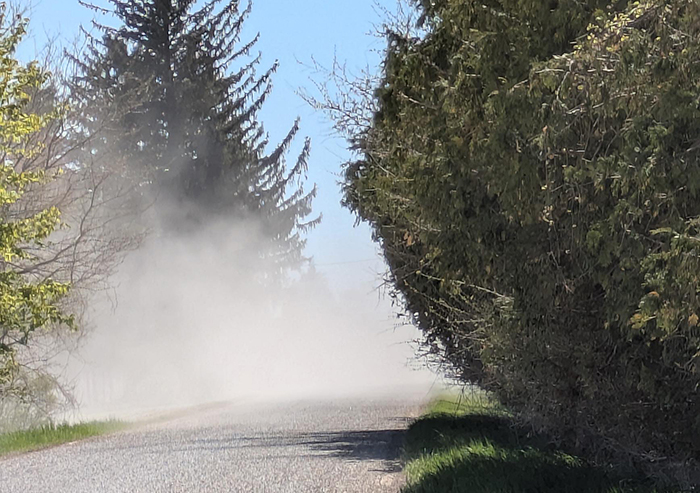
Rob and Lillian Melhuish are hoping Chatham-Kent will reverse a decision made at budget time to stop applying dust suppressant on gravel roads.
The retired couple, who lives on Smoke Line near Thamesville, said the municipality’s move was short-sighted and discriminates against rural dwellers.
“It’s an important issue for those who live on gravel roads,” Lillian told The Voice in a recent interview, noting she walks the road every day, and dust is a problem.
“I want to see if there’s any chance the dust suppressant can be reinstated.”
Chatham Coun. Michael Bondy, one of the councillors who voted in favour of removing the suppressant, was expected to bring the issue back to council for discussion at the May 26 meeting.
Bondy said he wasn’t aware of how important the matter is to country dwellers at the time but learned more about it after attending a Kent Federation of Agriculture meeting.
“The guys said you (council) burned us,” Bondy stated, noting council was told by administration the suppressant doesn’t work.
“But it does work when it’s put on at the right time in the right way,” Bondy explained. “This is a major, major inconvenience for people living in the country and the roads are terrible without it. If we made a mistake, we need to admit it and fix it. It’s a pretty simple fix.”
Last November council voted to stop applying the dust suppressant at a savings of $1.3 million, despite Wallaceburg Coun. Carmen McGregor’s bid to continue. Instead, council opted to funnel more money towards converting gravel roads to hard surfaces, which could be asphalt or tar and chip. But because Chatham-Kent has 1,765 kilometres of gravel, critics say the plan will barely make a dent.
At the time the decision was made, council heard from administration that applying dust suppressant was not an effective use of dollars and that many Canadian municipalities are moving away from the practice.
According to Lillian, that means only 9.27 kilometres of road will be resurfaced over the next three years.
“We don’t ask for very much out here,” she concluded. “When you see the millions being spent on the Civic Centre, the Merlin roundabout and tiny homes, we’d like to be taken care of.”