
By Pam Wright
Local Journalism Initiative Reporter
Canadian civil rights activist Hugh Burnett proved the pen is mightier than the sword.
As a Black man in the 1950s, the Dresden native used his writing skills and gifts of persuasion – including leading sit-ins at local businesses – to help create legislation to end discrimination against people of colour.
As a co-founder of the National Unity Association (NUA), rooted in Dresden, Chatham and North Buxton, Burnett’s activism was sparked following an incident in his hometown. After returning from military service in the Second World War, the veteran was refused a cup of coffee in a Dresden restaurant while in uniform.
That prompted Burnett to write federal Justice Minister Louis St. Laurent about discrimination in Kent County. St. Laurent wrote back that discrimination wasn’t illegal, in turn prompting further action by Burnett and the NUA.
Their advocacy helped push for the creation of Ontario’s Fair Employment Practices Act in 1951, and the Fair Accommodation Practices Act in 1954 – the first laws to end discrimination based on colour.
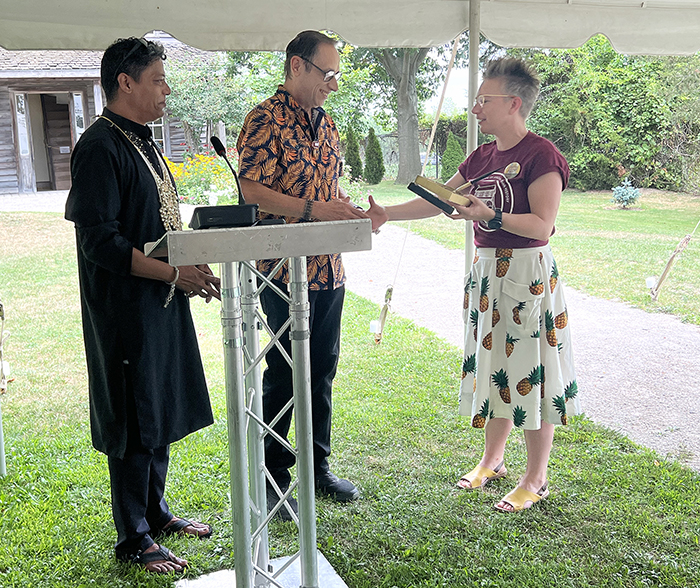
Now, nearly seven decades later, an engraved pen set, gifted to Burnett by members of the NUA in 1957, has made its way back to Dresden. On Emancipation Day Aug. 1, marking the date in 1883 when the British Empire abolished slavery, the artifact was donated to the Ontario Heritage Trust to become part of the collection at the Josiah Henson Museum of African-Canada History.
Ontario Heritage Trust CEO Helen Chimirri-Russell, who accepted the pen from Dresden residents Stefan Premdas and Thomas Peacock, pointed out the significance of the gold-tipped quill pen.
“Each object can help us better understand this site, the community and the people who shaped it,” Chimirri-Russell told the crowd. “History lives here.”
The engraving on the pen set states it was presented to Burnett, a descendent of slaves, by the NUA “in recognition of outstanding work for civil rights” from 1950 to 1954.
According to historical documents, so-called Jim Crow practices were alive and well in the 1950s. These were the rules of segregation that kept Black and white people from accessing the same services, such as separate bathrooms, water fountains and churches.
Even though Dresden was home to Uncle Tom’s Cabin, today renamed the Josiah Henson Museum of African-Canadian History in honour of esteemed abolitionist Rev. Josiah Henson, racial discrimination was evident in the town.
In Maclean’s Magazine in 1949, a journalist wrote an article titled “Jim Crow Lives in Dresden,” outlining discriminatory practices of the time. In the early 1950s, Dresden council voted to keep Black people from entering stores.
In 1954, the National Film Board of Canada released ” The Dresden Story,” a documentary examining systemic racial discrimination against Black residents of Dresden. The film captured local perspectives on civil rights – both Black and white – and features commentary from Burnett himself.
How the pen returned to Dresden is another story. Burnett, who moved to London after Dresden, died there in 1991. His commemorative pen was discovered at the city’s Renew Community Thrift Store in London earlier this summer. Staffer Monica Black recognized its importance and reached out to Premdas and Peacock, as she knew of the pair’s reputation for social justice, including past work with church groups and their current work fighting the York1 landfill at Dresden.
The two jumped at the opportunity to return the pen to its rightful place.
“We’re very proud to bring something like this back to the community that will continue to inspire future leaders to take up the pen,” Premdas said. “In 1833, a stroke of a pen was able to free a lot of slaves. It was the pen, it was advocacy, it was legislation that brought about freedom, equality and DEI, which is still the conversation today.”
It took until 1884 for the British to take action to release 800,000 slaves through the Emancipation Act. But Jim Crow laws continued to exist until the province and federal governments took action – in part as a response to activism from Burnett and the NUA.
The situation, including sit-ins at two Dresden restaurants who continued to refuse service to Blacks despite the new laws, drew outrage from outside Kent County. Prominent Canadian journalists took up the cause.
Today, it’s widely acknowledged that Burnett’s actions helped lay the foundation for protections enshrined in the Ontario Human Rights Code.
A few of Burnett’s relatives in attendance on Emancipation Day said they grew up hearing about Burnett.
Sisters Wendy Chambers and Beth Spencer, second cousins of Burnett, remember him as a tall man who ran a carpentry business in Dresden. The stories of his activism were shared by their parents.
“We always were told about what he did and what his role was,” Spencer said, noting as children, the sisters were cautioned to not go into certain stores in Dresden.
“We were told to be careful ourselves.”
Sherman Highgate, another cousin, said he remembers Burnett, who was 10 years older, from when he was a small boy.
And while he can’t remember Burnett giving any speeches, Highgate was always aware of the difficulties Burnett and other Blacks faced in Dresden.
“He was one very determined individual,” Highgate stressed, noting it took a great deal of fortitude for Burnett to stand up to racists. “Once he decided to get something done, don’t get in his way.”
• Historical information for this article was gleaned from Ontario Heritage Trust, the National Film Board, Maclean’s Magazine and the Canadian Encyclopedia.