By John Rhodes
Special to The Chatham Voice
At one time, all of the Thames River bridges between Lake St. Clair and the Prince Albert Road could be opened; these included railway bridges on the east side of Chatham (C&O) and at Pikeville (CPR) in Chatham Township. Those two crossings are still there but inoperable.
Typical of river structures of 100 or more years ago was the bridge at Third Street.
The first bridge to cross here was built in 1856 and was unusual in that it was built by a private stock company with funding to be recovered by bridge tolls. The sponsoring group ran out of money and the project had to be completed by the Town Of Chatham.
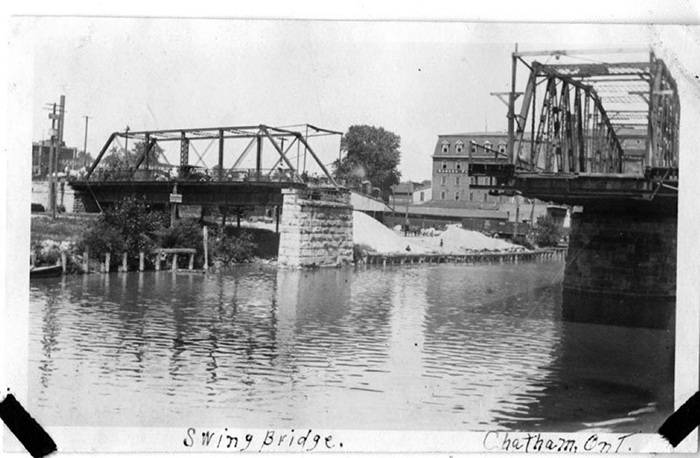
A second bridge at Third Street was built in 1874 and it was replaced in 1892 by the structure shown in the included photo. It was a swing type and rotated on a massive pier in the middle of the river. The structure was perfectly balanced and could be opened by one man with a large turning key.
In 1905, this structure was upgraded to railway strength in order to accommodate the street cars and rail freight of the CW&LE. There was, however, some miscommunication occurring between the City and the railway and this resulted in the railway construction workers being flushed off the bridge by the Chatham Fire Department. The steam fire engine on display at the Civic Centre would have been involved in the confrontation.
In 1930, this bridge was nearly destroyed when an overloaded CW&LE bulk car went crashing through the deck of the bridge, putting the span out of service for several months. This, to a great extent, was the end of the CW≤ they had discontinued their street car service in 1927 and were meagrely clutching to existence in the freight business.
The bridge was rebuilt and remained in operation until being removed circa 1960 and replaced by a lift span which was rebuilt a couple of years ago.
River traffic was a major issue until the 1950s but is no longer a factor.
The background contains a large gravel and coal yard to the immediate east of the Third Street Bridge; this was known as the Blonde Dock; next east to this point is the substantial Canada Flour Mills complex which was destroyed in a 1930 fire.
I remember once being shown a cereal box titled “Stevens Breakfast Food,” which was a product of this mill and named in honour of Nathan Hall Stevens, one of the owners.