By Pam Wright
Local Journalism Initiative Reporter
Four Chatham-Kent councillors are raising the alarm about the scope of the proposed waste-to-energy anaerobic digester project proposed for west Chatham.
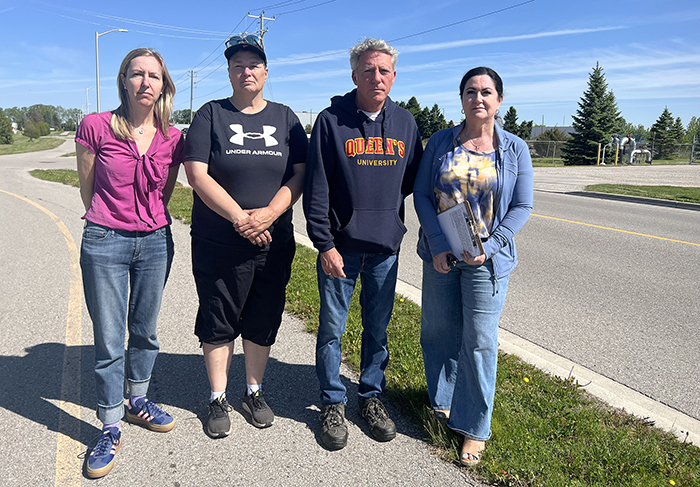
On Friday, Michael Bondy, Amy Finn, Rhonda Jubenville and Alysson Storey held a press conference on Bloomfield Road across the street from Greenfield Global Inc. to air concerns about the recently approved renewable energy project set to take shape on municipally owned land adjacent to Greenfield’s industrial complex.
The number one concern, they said, is that information listed on the Environmental Registry of Ontario (ERO) website states the development will be able to accept 900,000 tonnes of material per year.
That’s a discrepancy of some 530,000 tonnes, the four said. When council approved the project April 27, they added that they believed only 370,000 tonnes of waste would be accepted by the facility each year.
“That’s not what we voted for,” said Storey, a Chatham councillor, adding the group wants to alert the public about the ERO discrepancy.
“We’re hoping for some additional information to clarify the discrepancy,” Storey explained. “But we haven’t had that yet. We really need the public to be aware what was approved by council April 27 is not what’s being applied to with the province.
“That raised some red flags,” she said, adding some councillors have been seeking answers at the recent council meetings without a “clear” response.
In a municipal document received after the press conference, The Voice has learned the 900,000 tonnes per year (TPY) figure reflects the “total Environmental Compliance Approval capacity” of the facility.
Simply put, it means an application must incorporate the total flow that will go through the plant encompassing the 450,000 TPY that flows through Greenfield in a separate industrial wastewater treatment stream.
According to Chatham-Kent Public Utilities Commission general manager Darren Galbraith, the 370,000 tonnes discussed is the true amount of organic feedstock to be fed into the digester.
“There is no residential organic matter being brought to this project,” he added, noting while the primary feedstock comes from Greenfield itself, other sources include biodegradable castoffs from a brewing facility, as well as sludge from the PUC and the Wallaceburg water treatment plant.
That amounts to only five additional trucks per day, Galbraith explained, adding Greenfield has around 100 already coming to the complex daily.
Galbraith said the 900,000 TPY number was compiled by the consulting firm RWDI and Greenfield as part of a 600-page application to the province.
“This should not be interpreted as the design or operating capacity or the imported waste tonnage to the digesters,” the report states. “What conclusions people seem to be making about the 900,000 TPY amount (believing that this means the plant is larger) are inaccurate. Rather, the permit approvals to the province needed to reflect that this is a combined project and all the flows need to be accounted for in permit approvals.”
The 45-day online public consultation period, as defined by the ERO, opened April 20 and closes June 4. The TPY disparity was stumbled upon by a constituent, North Kent Coun. Rhonda Jubenville told reporters, which she said raises additional concerns about the process.
The waste-to-energy project, a collaboration between Greenfield and the Chatham-Kent Public Utilities Commission, has been in the works since 2021. Patterned after a similar Greenfield Global plant in Varennes, Que., the $160-million initiative will see the construction of a digester to convert industrial, commercial and institutional organic waste into renewable natural gas.
The public-private partnership will 60-per-cent-owned by Greenfield, while the municipality retains 40 per cent.
It’s estimated the digester will generate $123 million in dividends over the next 30 years for the municipality offsetting any taxpayer impacts.
A sizeable amount of the project’s funding is coming through senior government agencies.
“No matter how you feel about the project, we want to encourage the public to make their concerns known on the ERO’s public consultation form before the June 4 deadline,” Storey stressed.
In her comments, Coun. Finn said public consultation around the waste digester has been inadequate.