
By John Rhodes
Special to The Chatham Voice
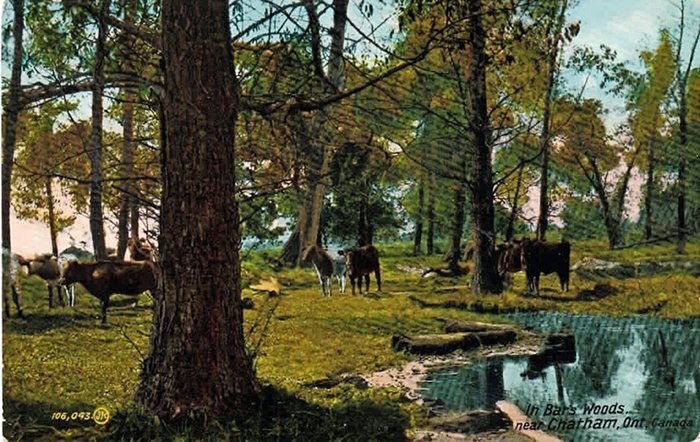
Barr’s Woods; did you ever hear of that place?
I will tell you where it was later in the story.
Robert Barr was a military doctor, born at Paisley, Renfrewshire, Scotland in 1796. He studied medicine at Glasgow University and on graduation he joined the British Army for service in the Caribbean. He was stationed at Tobago, a place he came to love, but when his enlistment expired he chose not to remain there. Instead, he came to Chatham, at which he arrived in 1838.
At the time, the Rebellion of 1837 was still in process and that may have had something to do with his decision to come here.
Dr. Barr obtained a considerable piece of property just west of the town, in Raleigh Township, which he called “Tobago Farm.”
It was bounded, roughly, by the river on the north, Inshes Avenue on the east, Park Avenue on the south and Merritt Avenue on the west. He practiced medicine from his home on the south river front, near what is now 44 Inshes Avenue.
He was married to Mary Campbell who was born in Scotland in 1822 and died at Chatham in 1895;
Dr. Barr died in 1877 and rests in the family plot, Old Ward A, MLC; his being one of the earliest burials in what was then a recently dedicated cemetery.
Over time, Tobago Farm was reduced and divided by intrusions such as the Great Western (Via) Railway, the Canadian Pacific Railway, Richmond Street, Harvey Street and the westerly residential expansion of the town. The last of Tobago Farm was consumed by the Dominion (C&D) Sugar Company during the First World War.
The location of Barr’s Woods? It is the playground at Winston Churchill School.