
By Pam Wright
Local Journalism Initiative Reporter
Bev Williams was only four years old when she was taken from her home on Walpole Island to Shingwauk Residential School.
She spent three years there in the 1950s and it changed her life.
“Before residential school, I was loved,” Williams told the crowd gathered to mark the fifth annual Healing Walk for Truth and Reconcilliation in Wallaceburg. “I was happy. I was safe. I felt trusted. However, after spending three years at the school, this all changed.”
Long cold walks, hunger, loneliness, fear, pain and discomfort marked her days at the Sault Ste. Marie facility, Williams said, adding that even after she returned home, she felt “disconnected” from everything.
“It was difficult for me to fit in,” Williams explained. “I felt different.”
The feelings followed her into adulthood, Williams said, adding she became an alcoholic to “hide my hurt and pain.”
She married and had four children but never spoke of her experience at residential school.
“In fact, I buried that terrible memory,” Williams said.
However, the suppressed memories negatively impacted her parenting, with Williams saying she put “fear” into her children which led to profound feelings of fear and shame.
Later in life, when employed in the social services field, Williams said she found out she had to “learn about herself” before she could help others. That led her to begin her healing journey, and with the help of Walpole Island elders, she returned to Shingwauk and began retracing her steps.
“I learned to love myself,” she said, and as a result, she learned to show love to her children and how to protect them.
“I learned why I abused my children and it was due to unresolved trauma.”
Telling her story is part of her ongoing healing journey, Williams stressed, adding it becomes easier each time she shares it.
“Telling our stories is important,” said the soft-spoken elder. “People need to know the truth. By sharing our truth, we heal, and we can educate others.”
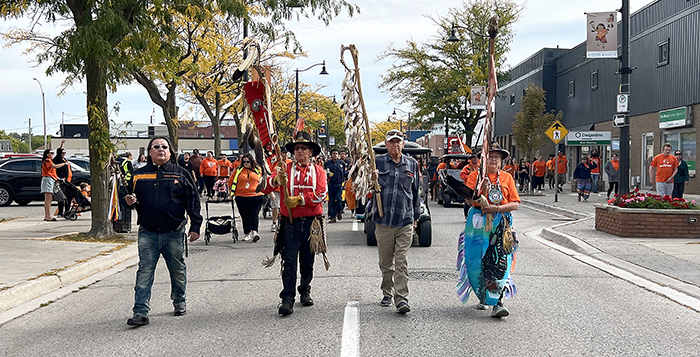
Williams was joined by Bill Sands and Jennie Blackbird, who also told their stories about residential school, as part of the survivor’s’ circle at the Civic Square Park ceremonies. A growing tradition, the Sept. 30 walk turned downtown Wallaceburg into an all-ages sea of orange, with survivors, supporters and local school children walking the length of James Street from the library to the park.
An honour guard led the procession, followed by prayers, songs, dancing and the testimonials.
Walpole Chief Leela Thomas, who emceed the event, and Chatham-Kent Mayor Darrin Canniff, who offered the land acknowledgment, both spoke of the importance of working together.
Thomas, who helped launch the walk while working with Walpole Island employment services, said truth and reconciliation is about “bridging our communities, building relationships and helping each other build supports in our communities.
“We are neighbours,” she told the gathering. “We have families all over here in Chatham-Kent. Today we gather with heavy hearts, but also with strength and courage and a shared responsibility to remember, reflect, and honour the children who never made it home and our survivors of residential schools.”