
By Pam Wright
Local Journalism Initiative Reporter
Following a recent weekend of emergency water restrictions, thousands of Chatham-Kent residents have a new appreciation for turning on the tap.
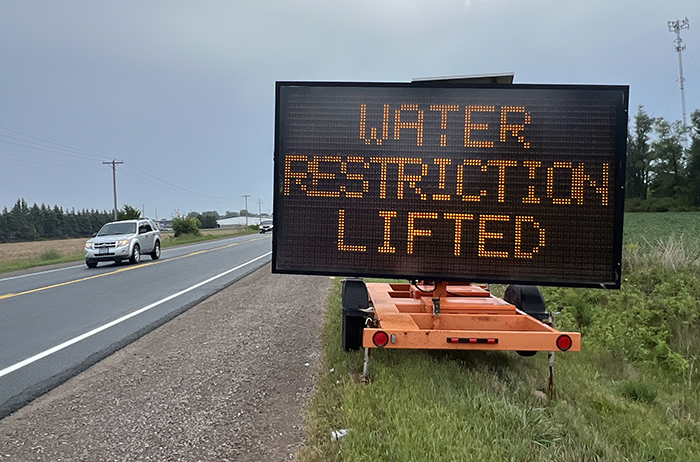
As do Chatham-Kent’s municipal leaders. On Aug. 31, the day severe water restrictions were lifted, officials held a media conference detailing what led up to the water shortage and how it was handled.
Rob Bernardi, director of engineering and compliance for the Chatham-Kent Public Utilities Commission, told reporters the problem arose following the scheduled repair of a leak. The work was completed successfully Aug. 27, but when staff started to slowly fill the transmission line, air was inadvertently introduced into the pipe.
In turn, this slowed the Chatham Water Treatment Plant’s ability to purify the water.
Because water couldn’t be processed fast enough, officials issued the severe water restrictions on Aug. 29 for Chatham and surrounding communities, reaching from Mitchell’s Bay to Thamesville. Businesses were asked to curtail water use and residents were called on to conserve by avoiding showering and doing laundry.
At no time was water quality impacted, Bernardi added.
“Nothing was compromised, it was just air being brought in,” Bernardi explained. “We were treating water; we just weren’t treating it quickly enough to get enough out the door to consumers.”
In addition, he said the system was unable to adequately replenish its reservoirs so, the restrictions were needed, as levels had dropped due to work on the transmission line.
“From a public utilities standpoint, we were able to track down the issues we were having,” Bernardi explained, adding staff worked “around the clock” to fix the problem.
And while the 36-inch pipeline has points where air can be bled off, Bernadi said air was trapped in points that couldn’t be reached.
Restrictions were lifted the morning of Aug. 31 after the system was restored.
But if it hadn’t been, large users would have been asked to stop using water completely. Next steps would have called for a boil water advisory for all users who draw from the Chatham plant.
“We were getting down to a point where we were worried that we would run out of water,” he said, “but as it turned out, the plant came back and we were able to start producing enough water to build our reserves again.”
Built in 1971, the 22-km line draws water from Lake Erie from the intake at the end of Charing Cross Road. The line transports around 36 million litres of water per day for customers in C-K.
Normally the Chatham water treatment plant has 35 million litres in reserves, but during the shortage, reserves were down 60 per cent. Water reserves normally represent about 18 hours of average water use for 43,000 customers.
Currently, the CKPUC is updating its water and wastewater plan and supply is one of the items being examined, Bernardi explained, noting the PUC is currently in the process of building another water reservoir for backup.
Mayor Darrin Canniff commended municipal staff and the public for coming together to conserve water.
“Bottom line, it was a great community effort,” the mayor said. “I know that individuals and businesses stepped up big time to make sure we averted any issues. This really demonstrated what Chatham-Kent does well. We came together as a community.”
CAO Michael Duben said the recent restrictions are a good reminder.
“It’s situations like this that sort of remind everybody how valuable a commodity water is. We’re surrounded by lakes and rivers here and we just take for granted that water’s always going to be available.”
He also commended the public, noting they helped make a “huge difference” by reducing consumption.
Duben said the team will complete an after-action debriefing report that will be turned over to council.