
By Pam Wright
Local Journalism Initiative Reporter
Homelessness, jobs and the economy, property taxes and housing affordability are top of mind for residents in Chatham-Kent.
In that order.
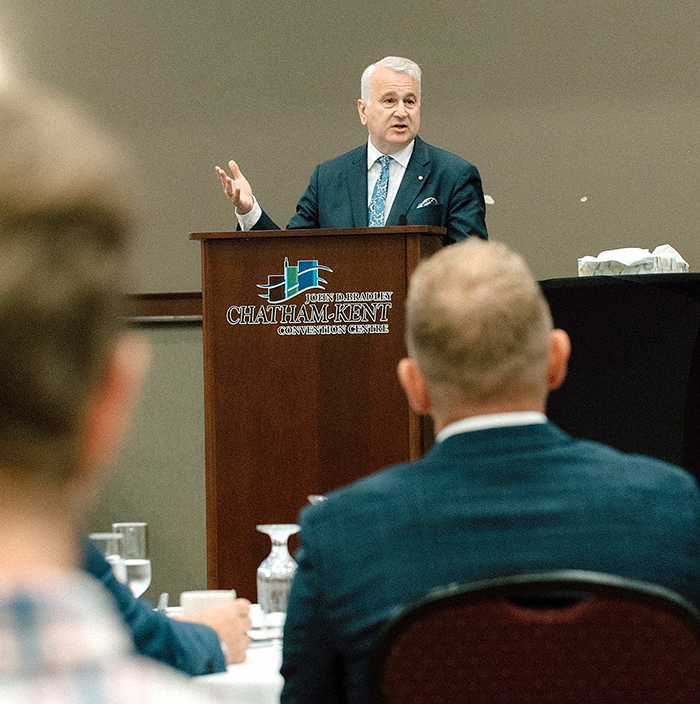
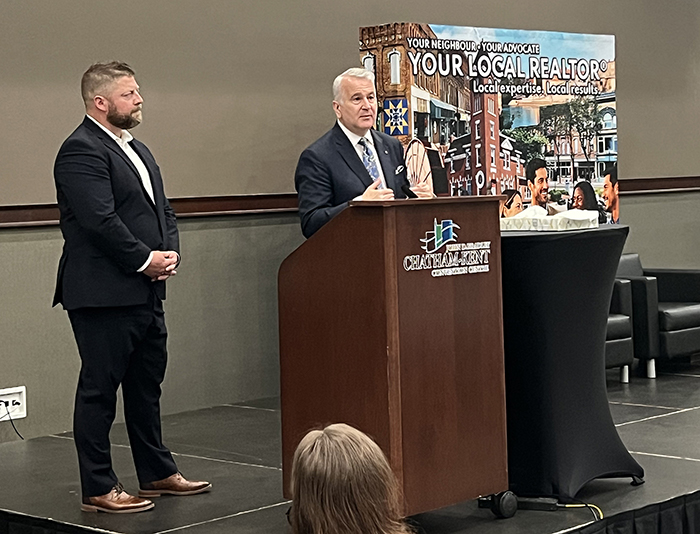
That’s according to a Nanos Research survey released at a recent Housing Affordability Summit. Held at the John D. Bradley Centre June 22 and hosted by the Chatham-Kent Association of Realtors, the event brought together stakeholders, industry leaders and government officials to discuss ways to solve the local housing affordability crisis.
Renowned data scientist Nik Nanos, who serves as official pollster for CTV News, kicked off the summit by presenting the results of the survey conducted from May 4 to May 12. While the majority polled reported they believed Chatham-Kent is a good place to live, Nanos said most are worried the next generation won’t be able to afford to call C-K home.
“Overall, residents of Chatham-Kent see the region as a safe and good place to raise a family with a high quality of life,” Nanos told the crowd. “People are really worried about the affordability of housing.”
Also of note, Nanos said, are concerns about taxes, as 23 per cent of residents polled would consider leaving Chatham-Kent if property taxes continue to climb.
“They’re also worried about increasing property taxes and how that might impact affordability,” Nanos explained, stressing that elected officials need to take the statistic seriously.
“This should be a big signal to local politicians,” he said. “Some people love living here and they want to stay here but they might be forced to leave if property taxes get too high.”
While homelessness is the number one concern, Nanos said C-K “isn’t special,” as the issue is impacting communities right across the nation.
And while people aren’t experts in housing policy, they do want to see changes, he added, as 67 per cent of those polled indicated.
“They do want action,” Nanos stressed. “Housing affordability has now been a top issue for the last four years (in Canada) and people are worried about it whether they live in a big city or a small town or rural area.”
As for addressing tax increases, Nanos said C-K needs to be competitive.
“This is an opportunity for leaders in Chatham-Kent to convey how competitive they are in terms of affordability. If it’s behind, it (the municipality) will suffer.”
The Nanos survey results showed 37 per cent of respondents saw homelessness as the number one issue, with jobs/economy and property taxes hovering around 20 per cent, followed by housing affordability at 15 per cent.
Other data revealed in the survey showed only half of those polled believe C-K has good quality health care; only 44 per cent think it’s a good place to run a business, and just 24 per cent think the municipality is a good place to take public transit.
The remainder of the survey answers were a mixed bag. It should be noted that the survey respondents were drawn equally from Chatham proper and outlying rural communities.
In her comments, CKREA president Carrie Patrick said the housing affordability crisis can’t be solved by any one sector, adding “everyone deserves a home.
“This summit demonstrated the value of bringing realtors, home builders, agricultural leaders, greenhouse growers, government representatives, and community stakeholders together around the same table,” Patrick said. “Meaningful progress happens when we build relationships, share perspectives, and work collaboratively toward practical solutions that reflect the realities of our region. Today’s conversations are an important step, but they are only the beginning of an ongoing commitment to advocacy, partnership, and action.”
The summit was funded through a mobilization grant from the Ontario Real Estate Association.