
When you screw up and the result of that mistake is incredibly tender meat, that’s OK, right?
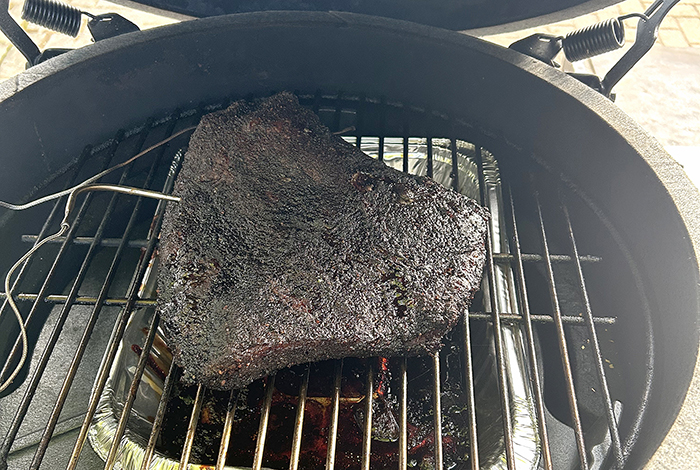
Well, we smoked a brisket recently and I have to say I was unhappy with the results. It wasn’t my first brisket, and it was incredibly tender, but I have to adapt my process before I do it again.
We picked up the brisket from Schinkels’ Friday afternoon, seasoned it that night and put it on the Big Green Egg about 8 a.m. Saturday morning. Low and slow was the plan. About 250 F for a long cook.
However, I wanted a bark around this brisket, so I used less water in the drip pan. That might have been mistake No. 1.
However, before I dabble in the mistakes, let’s talk about outcome. The brisket reached 204 F after about 11 hours of cooking. We let it rest for an hour and then sliced it up for dinner.
It was very tender, yet was missing a few things.
First off, there was no visible smoke ring, where the first 1/8th of an inch or so was a visibly different colour than the rest of the meat.
Second was there was less flavour than I remember. We had used an Espresso BBQ Rub that we love on other beef we’ve done, but it didn’t seem to penetrate.
The next day’s meal was better, as we reheated slices of brisket in a dish with beef broth and barbecue sauce for about 30 minutes. The sandwiches we made were excellent!
So, what to do next time? Well, first off, my wife thinks I should get up at 5 a.m. to cook it so everything is done earlier. But I am thinking this becomes an overnight cook.
If I did that – put the brisket on at say 9 or 10 p.m., it could come off the following morning, and rest, and rest, and rest.
You see, letting the meat rest for an hour is the minimum recommendation for long cooks. The best is to let it sit for perhaps four hours, if not longer, at 140 F or so. This lets the juices properly redistribute back throughout the meat after retreating to the centre during the cooking process.
Now, there are two other options to help increase moisture. The first is to make sure there is more water in the drip pan so it is a more moist cook overall. But that could impact the bark on the outside of the brisket.
Or, we could pull off the brisket when it stalls during the cooking process (it sat at 160 F or so for probably two hours), wrap it in foil and cook it the rest of the way wrapped to lock in juices.
Regardless, at the beginning of the cooking process, I am going to make sure to add more wood chips to increase smoke and flavour into the brisket. I added a cherrywood disc, but it was over to one side of the charcoal, so I’m not sure how much impact it had on the flavouring.
There’s a lot to mull over, but nothing to dwell on. Even a bit of a fail on my part turned into some pretty darned decent meat.
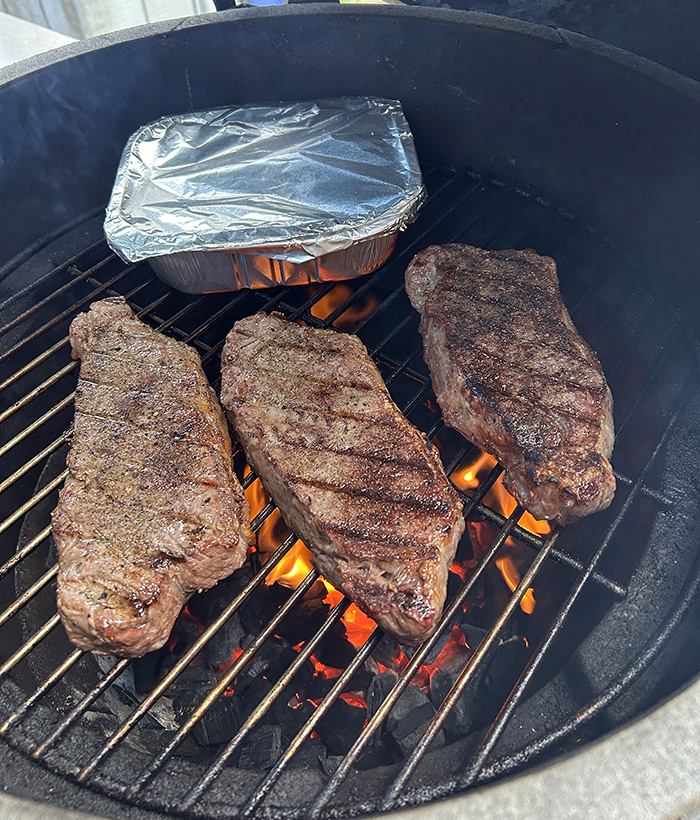
But I am hooked on striploins these days. We recently did some prime-grade steaks from Schinkels’ in the wake of our delicious Lenover’s steaks, and they didn’t disappoint.
However, that means we had multiple red meat nights in a week, with two of brisket and one of steaks, and I’m sure dieticians might suggest adding more fish and chicken into the equation.
No problem. Pulled chicken tacos were delicious this past week for more than one meal. Black beans make so much difference.