
By Pam Wright
Local Journalism Initiative Reporter
A single meeting is not consultation.
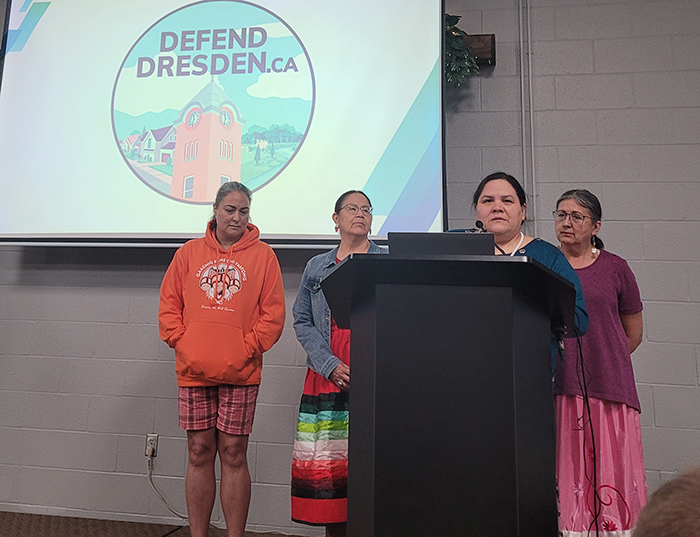
That’s what Walpole Island First Nation Chief Leela Thomas has to say regarding York1’s claim the company consulted with the band about the Dresden landfill project.
“A short meeting is not consultation,” Thomas told The Voice in a recent interview. “Consultation means we know everything that the project entails. This hasn’t happened and there’s been no attempt to reconcile our concerns.”
The chief’s comments were made public just prior to the Ontario government’s approval of Bill 5 on June 4. As part of the Unleashing the Economy to Protect Ontario Act 2025, the bill removes the environmental assessment designation for the York1 project, thereby fast tracking the controversial development located near the heart of Dresden.
According to Thomas, proper consultation with First Nations typically includes a notification from the government and the proponents of a project, in this case York1 Environmental Solutions Ltd. Normally, said Thomas, a capacity funding agreement would be discussed.
But Thomas said none of that happened.
“York1 never did that,” she said, noting WIFN had to reach out to York1 to find out what was going on.
Thomas, who was elected chief in September 2024, said a meeting was held with the previous administration on June 6, 2024, but no documents were signed and no official plan was ever presented.
There are no minutes from the meeting, she said.
“Normally with something like this, council needs to approve a resolution to accept the proposal. This never happened. York1 never offered any of this.”
Legal action by the band may be the next step. Thomas said WIFN will hire a lawyer and environmental specialists to determine the potential effects posed by the landfill.
“We have to make sure this does not impact our lives, our land and our livelihoods,” Thomas explained, noting she has never witnessed a legislative bill that specifically names a company.
WIFN Bkejwanong Territory, which in Ojibwe means “where the waters divide” is located near the mouth of the Sydenham River. Molly’s Creek, a small tributary that feeds the river, is located only steps from the York1 project. The Sydenham is a direct conduit into Lake St. Clair, part of the Great Lakes system. Millions of people on both sides of the border rely on the system for water.
When contacted by The Voice, the leader of Eelunaapeewi Lahkeewiit, the Delaware First Nation at Moraviantown near Bothwell, echoed Thomas, stating the band “has not been meaningfully consulted by York1” regarding the proposal.
In an email message, Chief Justin Logan said consultation is not about “being informed after the fact. It means being actively engaged from the beginning. That has not happened here.”
According to Logan, Bill 5 sets a dangerous precedent for all First Nations by fast-tracking projects without any input from First Nations people.
Logan said the legislation weakens environmental safeguards and undermines the principles of “free, prior and informed consent” as outlined in the United Nations Declaration on the Rights of Indigenous Peoples – a declaration Ontario publicly committed to uphold.
“We carry a sacred responsibility to safeguard our traditional territory – not just for ourselves, but for future generations,” he said.
In response to a question from The Voice regarding York1’s consultation with local First Nations, the company’s public relations lead said consultation has taken place. Laryssa Waler of Henley Strategies, said WIFN first reached out to York1 on May 17, 2024. This was followed by an in-person meeting at the WIFN band office on June 6, 2024.
Waler said York1 officials were present, as well as Tom Williams, the company’s principal engineer and hydrogeologist from XCG Consultants. The meeting was attended by “10 or more” representatives from WIFN, she added.
Indigenous leaders and groups have vowed to continue to fight the proposal, saying Bill 5 will spark opposition similar to what occurred during the Idle No More protests.
Those protests, which began in 2012, and were held nationwide, were conducted over what indigenous people saw as a violation by the then-Harper government over treaties between the federal government and First Nations.