

By Pam Wright
Local Journalism Initiative Reporter
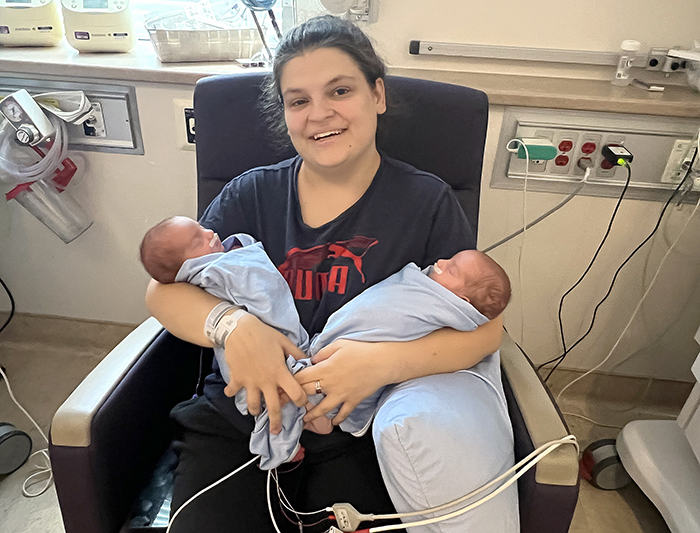
Chatham sisters Lilliana and Zoey couldn’t get any closer.
The identical girls, born July 23 in London, are classed as monoamniotic-monochorionic twins – the rarest type of twins, occurring in only one of every 10,000 births.
Delivered by caesarean section in London at 33 and a half weeks, Lilliana was the first to arrive, topping the scale at 4 lbs.14 oz. Sister Zoey, born a minute later, was five ounces lighter weighing in at 4 lb. 9 oz.
First-time parents Kaley Johnston and Arthur Rumble are over the moon regarding the addition to their family times two.
“He loves having kids,” said Johnston of the new father. “The first day he found out I was pregnant, he was excited.”
Plus, as she told The Voice the petite brown-haired babies are “identical” to dad.
Monoamniotic-monochorionic twins, commonly referred to as momo twins, are defined as babies who share a placenta and amniotic sac in utero. Momo twins are considered to be at high risk of cord compression and entanglement. They’re susceptible to host of other conditions, including the possibility of twin-to-twin transfusion syndrome, where one baby accesses the bulk of the nutrients from the mother.
Johnston, 22, found out she was pregnant on New Year’s Eve. Her first ultrasound on Jan. 7 revealed twins and a subsequent ultrasound at 12.5 weeks uncovered the fact she was carrying momo twins.
Johnston admits she was worried during the pregnancy because of the threat of complications.
“I was scared,” the new mom said, adding a deep research dive on the Internet didn’t help.
“I was very nervous about all the bad things I was reading about,” Johnston explained. “I was terrified at every checkup that something would pop up.”
But the expectant mom sailed through her pregnancy with no complications, although she was required to stay in hospital in London from 28 weeks onward.
Johnston is looking forward to bringing the babies home, noting she has a “massive village” to help care for them. Friends and family have supplied everything the girls need, including plenty of co-ordinated clothing.
“They’ll be matching forever,” Johnston joked.
Even though Lilliana and Zoey are genetic copies of each other, there is a slight difference, as Zoey has a skin tag on her ear that doctors will remove after her first birthday.
The girls were transferred back to the Chatham-Kent Health Alliance at 10 days old. Initially on feeding tubes, Lilliana and Zoey are gradually transitioning to bottles and mom’s breast milk.
Chatham’s Dr. Samuel Enokela cared for Johnston through her pregnancy, while the babies were delivered at London Health Sciences by Dr. Robert Gratton.