

Chain for change
By Pam Wright
Local Journalism Initiative Reporter
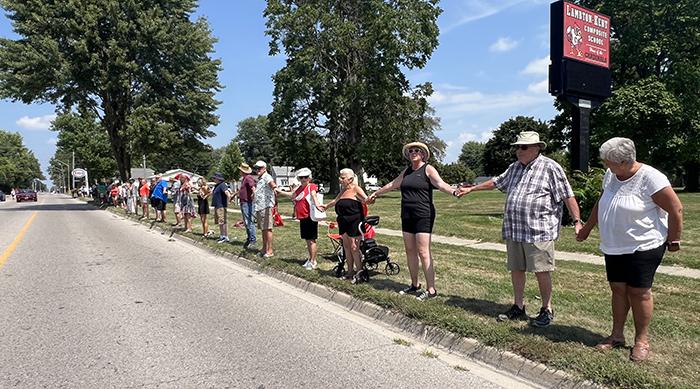
Despite sizzling temperatures, dozens showed up in Dresden Aug. 10 to protest the York1 dump expansion north of town.
The human chain event – aimed at raising awareness about the negative impacts of the proposed landfill – saw young and old alike line the roadway from the York1 site to the local high school.
Dresden’s Bob Vincze was among the protestors. Using a walker, the senior linked hands in solidarity with Walpole Island First Nation (WIFN) Chief Leela Thomas at the entrance to the York1 property at 29831 Irish School Rd.
“It doesn’t make sense what they are trying to do,” Vincze told The Voice when asked why he came out. “A landfill is supposed to be 3.5 kilometres from town. I care about Dresden and that’s why I’m out here.”
 Vincze pointed out it’s “stupid” to truck construction waste from the Greater Toronto Area to Dresden – a distance of close to 300 kilometres.
As it stands, the development is only 800 metres from the town’s sign and mere steps from Molly’s Creek, a small tributary feeding into the Great Lakes system.”
WIFN Chief Thomas said it’s important to continue to protest Ontario’s Bill 5, which passed in June.
“Even though the bill is passed, we have to continue to oppose it,” Thomas said. “We have to educate the province about what’s happening and the potential impacts it could have. There’s still potential to get it revoked. We have to figure out what we can do to support each other.”
As part of Bill 5, the Protect Ontario by Unleashing Our Economy Act, the Ford government removed a comprehensive environmental assessment from the York1 project. The province maintains the landfill needs to move forward because of the tariff threats posed by U.S. President Donald Trump, which could close the border to trash from this province. Ontario currently ships 40 per cent of its waste to Michigan and New York state.
In 2024, York1 applied to build an eight-hectare landfill on a 35-hectare site designed to accept up to 365,000 tonnes of construction waste annually, or 1,000 tonnes per day.
A regenerative recycling facility will also be built to take in as much as 6,000 tonnes of non-hazardous construction and demolition waste each day, along with a leachate ponding system designed to process soil. As many as 700 trucks could be transporting waste to the Dresden site every day.
Angie Mills-Richards, one of the chain organizers, said Premier Doug Ford would reject the Irish School Road development if he could see the site himself.
“Doug Ford, please come and listen to us and see where we’re at,” Mills-Richards said, stressing the far-reaching impacts the project will have on the environment and the farming community.”
The development is located near a creek, abuts land critical for growing crops, is located near the Conagra food processing plant and the fact it could affect the aquifer feeding local water wells are issues that are also top of mind, she added.

Mills-Richards, who along with husband Mike Richards, owns farmland in the landfill’s buffer zone, is also worried the province may step in and expropriate their land.
“There’s no way they’re getting our land. We’re going to fight it all the way and we will continue to fight this for our kids, our community and the generations to come.
“We need help, we need support and for the government to realize this is serious,” she said. “What they’re doing here by trying to fast track this project is a coverup. Under an environmental assessment, this project wouldn’t pass. Doug Ford has connections with York1. We know that for a fact.”
The York1 proposal has galvanized a wave of protest, with Ontario’s opposition party leaders, the Association of Municipalities of Ontario, the Municipality of Chatham-Kent and Environmental Defence Canada joining the fight.