
Local company uses a drone to protect crop from frost damage
The folks at Drone Spray Canada have successfully tested a new use for their merchandise – frost mitigation.
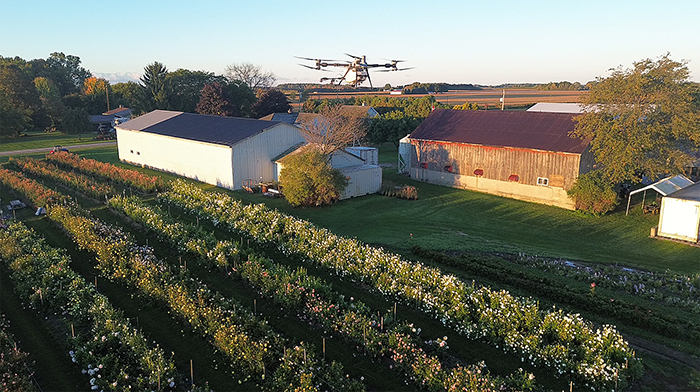
They recently sent their largest drone over a field near Thamesville in an effort to protect the flower crop from damaging frost.
“We were approached by a local grower in the Thamesville area,” Myles Weishar, marketing manager for Drone Spray Canada, told The Voice. “There was an early frost in the forecast.”
The landowner wanted to protect the dahlia flowers growing in a one-acre field from killing cold temperatures.
The idea was to find the warmer air above ground level and literally push it down over the flowers.
“We went out and tried it. We took the largest model we had, the T-100,” Weishar said. “We went out a couple of hours before sunrise.”
On site, the drone team lit a small fire to track how far the smoke rose into the sky. Where it stopped told them all they needed to know.
“Once the smoke hit the temperature inversion shelf, we knew where to be at,” Weishar said. “We just programmed it (the drone) and it flew up and down over a one-acre plot.”
The drone punched holes in the inversion layer to push down the warmer air.
He added where a neighbouring plot showed signs of damage from the frost, “it was pretty evident that it worked” over the plot the drone covered.
It’s another use for which these drones can be utilized.
The T-100 is no lightweight. Weishar said it has a “dry weight” of 165 lbs. When it’s loaded with liquid for crop spraying, it weighs in at about 400 lbs.
But the drone can also handle field seeding and dry fertilizing too.
“Spraying is certainly a primary function for these things, but you can get a lot more value with the cover crop seeding in the fall, and fertilizing,” Weishar said.
Essentially, it is up to the customer how to best utilize their drone. Maximizing efficiency is maximizing one’s investment.
Weishar said the larger drones like the T-100 have impressive lift capabilities.
“A Western Canada customer was transporting goods to and from a small island using an aluminum boat. They tried a drone, and it’s working out really well,” he said.
Drones are replacing heavy equipment at times, Weishar said. For example. When conditions could leave a farmer with a tractor bogged down in a wet field, why not used a drone to plant?
Furthermore, heavy equipment packs the soil. A drone doesn’t.
“There’s no compaction. You’re not getting tractor tires on the field,” Weishar said. “In years with tight weather windows and wet springs, there’s often nothing else you can do to get out there to plant your crops. This is a fantastic tool.”
Drone Spray Canada opened its doors in 2020, starting out as an application operation, and has now morphed into drone supply.
Blenheim-area farmer and pilot Adrian Rivard started the business, which now runs out of the former Handy Bros. building on Communication Road just north of Blenheim.
Today, the company sells and services DJI drones.
Weishar said they do still fly their products.
“We started out as custom operators. But we’re now a dealer too. We do still like to get out there,” he said.