

By Pam Wright
Local Journalism Initiative Reporter
Eight years ago, Doug Ford promised to end hallway health care in Ontario.
But that hasn’t happened, according to a new report from the Ontario Council of Hospital Unions (OCHU).
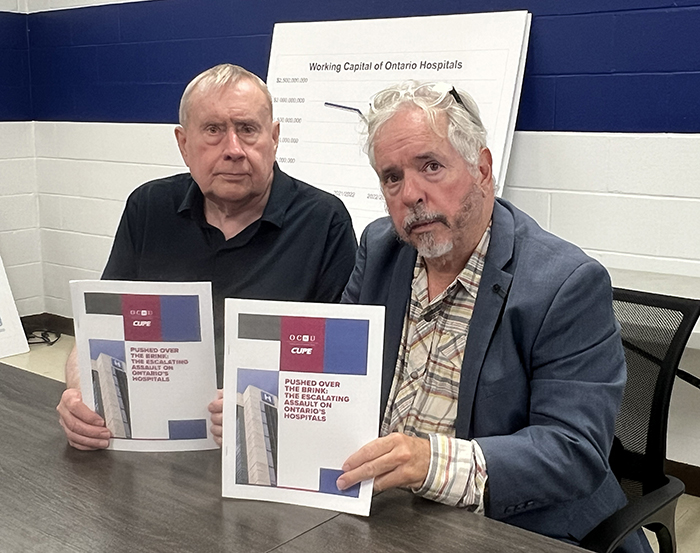
Titled “Pushed Over the Brink: The Escalating Assault on Ontario’s Hospitals,” the analysis details the difficulties Ontarians face in accessing health care, why the problem continues to grow, and how the OCHU believes it can be solved.
As part of a provincial tour to raise awareness about the issue, OCHU president Michael Hurley and CUPE senior researcher Doug Allan recently met with reporters in Chatham.
According to Hurley, a variety of factors are contributing to the fact that on any given day 2,000 Ontario resident patients are waiting on stretchers for a hospital bed to open up.
Plus, he said, an estimated 200,000 people are waiting for surgery, with 75,000 of those exceeding the medically recommended time frame.
“There’s incredible pressure on the hospitals and crowding,” Hurley told the media, noting aging baby boomers with complex care needs, advancements in care, rising costs and inadequate government funding combine to make the problem worse.
Allan, author of the report, said officials are calling on the province to restore funding back to levels it should be at a cost of $5 billion.
“Funding increases are just a little over half of what is actually needed,” he added, noting provincial austerity measures “began to bite” in 2025.
According to Allan, it’s a long-established fact that Ontario needs to increase hospital capacity, particularly as baby boomers age, with the province bearing the distinction of having the fewest beds-to-population ratio in Canada.
“Right now, we’re in the thick of it,” Allan stated, noting that 60 per cent of all hospital beds are taken by people aged 65 years or older.
“We have seen significant increases in total length of stay,” he explained, noting that while people are being treated “more efficiently,” the need for hospital services continues to mount.
At the Chatham-Kent Health Alliance, Allan said the hospital needs $32 million and more than 300 staff to bring it to an adequate standard.
“That’s the bump we need to get it back to the Canada-wide average,” he said, adding most Ontario hospitals are in the same shape.
In September 2025, the government forced all hospitals to create three-year hospital sector stabilization plans to come out of deficit. In order to meet the decree, the report indicates hospitals are cutting staff, with a loss of 1,300 jobs across the province in the last year.
In 2021, Ontario hospitals had $2 billion in working capital, but that’s now shrunk to a negative $280 million as of last December, the report said.
Allan noted CKHA is operating with a deficit of $18 million in working capital. By law, hospitals aren’t allowed to run deficits, but because that’s impossible, hospitals are forced to apply for “waivers” from Ontario Health.
In response to a query about the report, the CKHA issued the following statement.
“Chatham-Kent Health Alliance, like hospitals across Ontario, continues to experience financial and operational pressures driven by increasing patient demand, complex care, capacity challenges and rising costs. While we have not reviewed the CUPE’s report and cannot comment on its specific figures, our financial statements and performance indicators are publicly reported and reflect the ongoing challenges facing our organization,” the statement read.
“We continue to work closely with Ontario Health and the Ministry of Health to responsibly manage our resources while maintaining safe, high-quality care for our patients and community. Additional investments in hospital funding and health human resources remain important to ensuring hospitals can meet growing demand and continue providing timely access to care.”
Increasing privatization is another tactic the government is taking, Allan noted, adding it isn’t helping.
“Unfortunately, the government plans to expand that and there’s very solid evidence, that the wealthy are the ones who benefit from that privatization and everyone else is getting less,” Allan added.
The need for more provincial support is also being felt by people waiting for surgeries, such as hip and knee replacements, painful conditions which force some into isolation.
In turn, that’s led to people seeking treatment at private surgery clinics, with some people taking out loans or a line of credit to get procedures done.
Both Hurley and Allan stressed it’s difficult to get information from the province as to how Ontario’s hospitals are funded.
“We don’t have the plans that are being implemented in our hospitals,” Allan said. “We think communities deserve that and they should demand it.”
To help, Ontarians are being advised to make their concerns known to local politicians and ministry officials.
“Tell them your stories,” Allan said. “The government needs to meet its promise to end hallway health care.”
The council, serving as the hospital division of the Canadian Union of Public Employees, represents between 34,000 to 40,000 workers across a range of specialties.