The faith, resilience, and determination of the Francophone settlers who built a community that has thrived for more than two centuries were celebrated recently with the unveiling of two plaques in Pain Court.
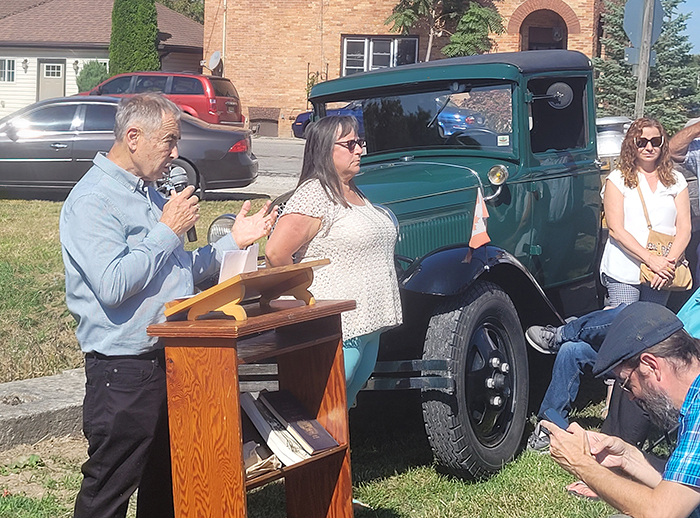
A crowd of nearly 100 gathered at the intersection of Creek Line and Winter Line Road for a ceremony celebrating both the past and future. The intersection is significant as the community’s first church, rectory, chapel, and cemetery were located there.
The two plaques (in English and French) were installed through the efforts of the Chatham-Kent Heritage Network. Network Chair Lisa Gilbert said the dedication of residents to their heritage has resulted in the “maintenance and rejuvenation” of French-Canadian culture.
French-speaking settlers from Detroit and the Montreal area set up along the local creek in the early 1800s. Many original settlers received title to their property for their service in the War of 1812.
Father Eugene Roy, former pastor of Immaculate Conception Church in the community, told those assembled that the name Pain Court came about because the early settlers could only clear enough land to grow a small quantity of wheat, thus producing “short breads.”
Paul Roy, the patriarch of the prominent Dover Township family, said Pain Court is unique in its place in Francophone culture, but also praised the community as one that has always welcomed others.
“The Belgians, Dutch, Polish, Hungarians, and Czechs came to work on the farms,” and in turn became valuable members of the community. “I went to school with many children who became trilingual because they knew the language of their homeland, and learned French and English.”
He said several notable people came from the community, including Joseph Caron who served as the former Canadian high commissioner to India and former Canadian ambassador to China and Japan; and former world heavyweight boxing champion Arthur Pelkey.
Gilbert said the heritage network has installed 18 plaques throughout Chatham-Kent and has plans for three more in October and would like to see future tours of historical sites in the community.
With three more plaques left to install next month, Gilbert is hopeful for future tours of historical sites in Chatham-Kent.
She told the crowd, “It’s so important to have people such as yourselves actually standing here. Making physical contact with people, talking. Some of them are your neighbours. Some of them are people that maybe you’ve never met before.”
Mayor Darrin Canniff echoed her words.
“People who don’t know the history of Pain Court can come here and pick up on that,” he said. “That’s the idea, bring people to Chatham-Kent … not let the history of our communities disappear.”